
A timegrapher for the kitchen table
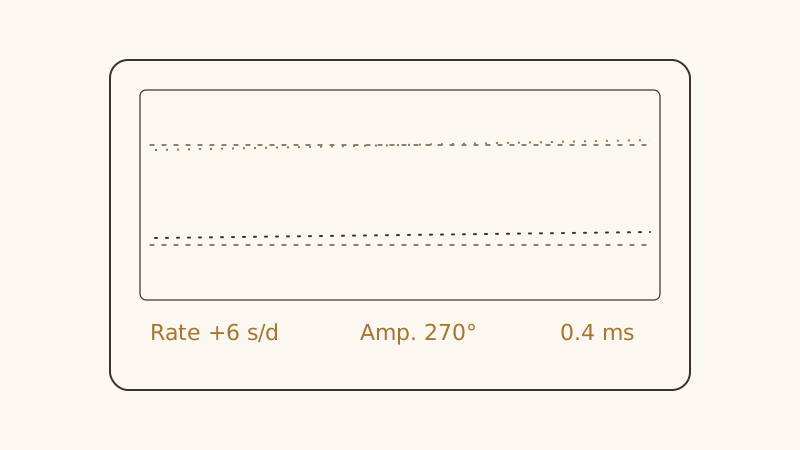
For a year I measured accuracy like this: set the watch in the morning by the radio, compare in the evening, write it down. It works, but it is slow, and you never know whether it is the watch or the position it was lying in.
For my birthday I treated myself to a timegrapher – in German a Zeitwaage, a “time scale”, which I find a lovely word. A simple device from China, like many hobbyists use. A microphone that holds the watch, and a small screen.
What you see
- Rate in seconds per day: does the watch gain or lose?
- Amplitude: how far does the balance swing? A healthy watch at full wind is somewhere between 250 and 300 degrees.
- Beat error: is the tick as long as the tock?
The first measurement of the Kienzle was sobering: plus 140 seconds a day, amplitude 190 degrees. The watch runs, but healthy is something else. Second measurement, after regulating: plus 12. I can live with that.
From now on I measure every watch in five positions before I open it, and after. The results go into a spreadsheet. Let us see what it shows in a year.
Comments are closed on this site. If you want to tell me something, see the notes page.